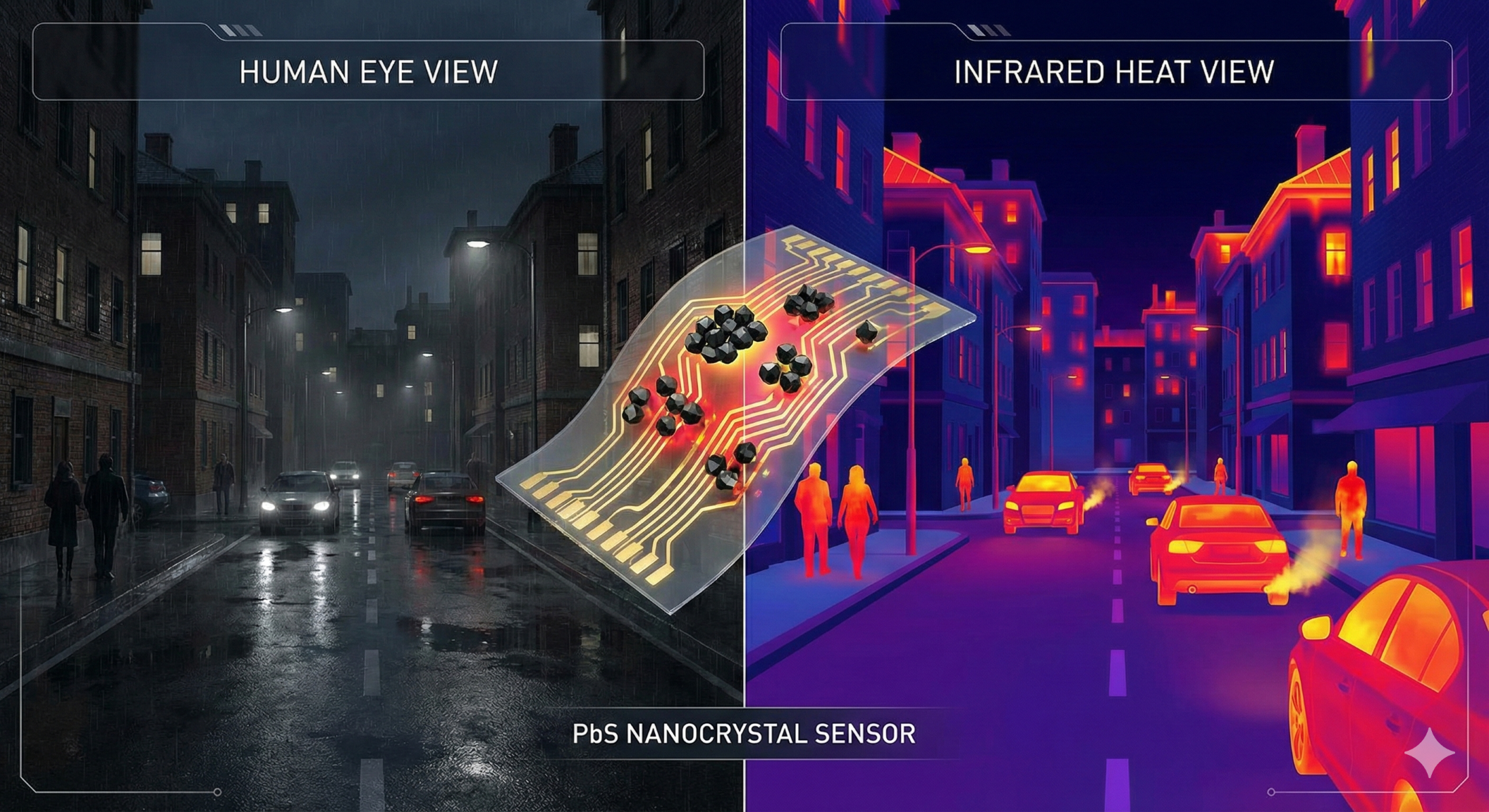
The world of high-end surveillance, medical imaging, and environmental monitoring has long been held back by a single, frustrating factor: cost. While the camera in your smartphone can capture stunning visible light photos for a few dollars, sensors that can "see" in the infrared (IR) spectrum—vital for seeing through smoke or diagnosing health issues—often cost thousands
The Breakthrough: Printing High-Tech Sensors
Traditionally, making infrared sensors requires expensive, high-temperature manufacturing. By using colloidal nanocrystals, scientists have found a way to "print" these devices at room temperature.
Why This is a Game-Changer:
- Extreme Affordability: The materials for a single detector cost less than 20 cents per square centimeter.
- Lightning Speed: Using automated robotic systems, a detector can be printed in just 14 seconds.
- Minimal Waste: Unlike traditional methods that "wash away" expensive materials, these printed drops use nearly 100% of the active material.
Comparison of Printing Approaches
| Feature | All-Inkjet Printing | Robot & 3D Printing |
| Method | Precise layer-by-layer jetting. | 3D frame with a single robotic drop. |
| Production Time | ~3 minutes per detector. |
~14 seconds per detector. |
| Scalability | Limited by nozzle clogging. |
Highly scalable for large arrays. |
| Detectivity ($D^*$) |
$\sim2\times10^{10}$ Jones. |
$\sim2\times10^{12}$ Jones.
|
The Future: From Lab to Living Room
Sources:
YousefiAmin, A., et al. (2019). "Fully Printed Infrared Photodetectors from PbS Nanocrystals with Perovskite Ligands." ACS Nano.
Killilea, N., et al. (2019). "Pushing PbS/Metal-Halide-Perovskite Core/Epitaxial-Ligand-Shell Nanocrystal Photodetectors beyond 3 µm Wavelength." Advanced Functional Materials.